
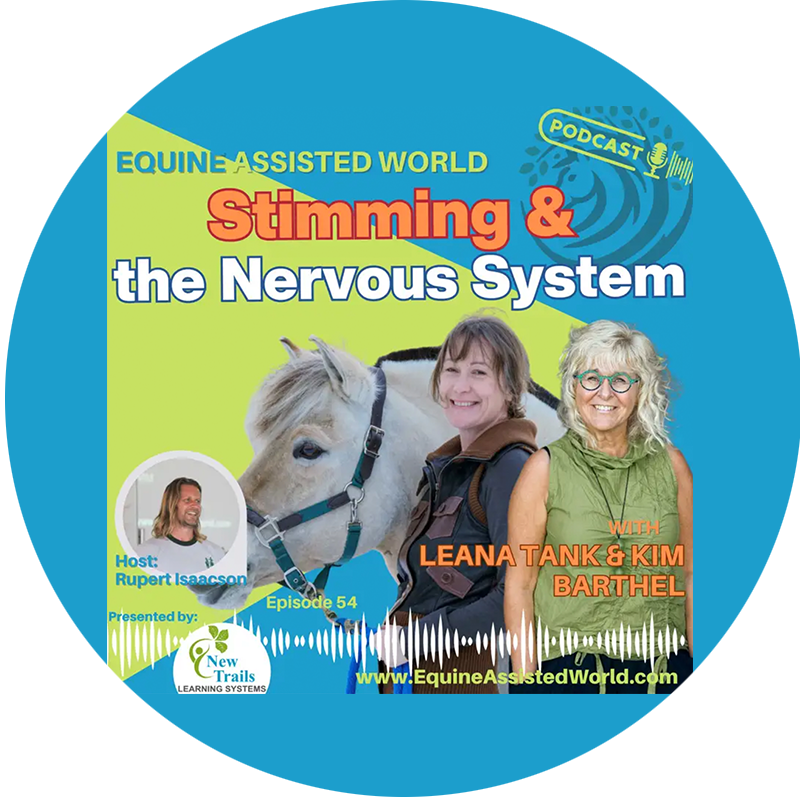
PODCAST: Equine Assisted World - What Happens After the Horse? Neuroscience Tools for Home & Beyond
Hosted by New York Times bestselling author and long time human rights activist, Rupert Isaacson is probably best known for his autism advocacy work following the publication of his bestselling book "The Horse Boy" and "The Long Ride Home" where he tells the story of finding healing for his autistic son.
From the podcast webpage: Kim Barthel is an occupational therapist, international educator, and author based in British Columbia, Canada, trained in sensory integration, neurodevelopmental therapy, and holotropic breathwork. Leana Tank is an occupational therapist and consultant working with complex populations including individuals in the criminal justice system, combining equine-assisted practice with deep expertise in movement, trauma, and the nervous system.
Together, they bring a rare combination of neurological precision and on-the-ground practicality to one of the most overlooked questions in equine-assisted work: what are you doing with your clients when they are not on — or with — the horse?
This conversation digs into the neuroscience of the vestibular system, interoception, bilateral stimulation, and why movement is far more than muscles. Kim and Leana share concrete tools — from saddle stools at home to pickle juice to the long gaze — and explore why the relational environment may ultimately matter even more than the physical one.
✨ "The brain can change until you stop breathing." – Kim Barthel
If you want to support the show, you can do so at Patreon: https://www.patreon.com/LongRideHome
🔍 What You'll Learn in This Episode
Why what happens off the horse — at the barn, at home, in the community — is just as important as the session itself
How the vestibular system develops in utero and why almost every developmental difference affects it
What the inner core muscles (diaphragm, pelvic floor, transverse abdominis, multifidus) have to do with regulation, interoception, and feeling safe
Why the horse's three-dimensional movement provides a backdrop the brain cannot easily access in stillness
What interoception is, why many autistic individuals experience a blurred boundary between self and world, and how horseback riding supports this
How to design simple home environments and daily activities that continue the neuroplasticity work between sessions
Why stimming is not a problem to fix but a movement toward wholeness — and how to support it constructively
What a "sensory diet" is and why individualized approaches work better than generic protocols
How bilateral stimulation (crossing the midline) integrates the two brain hemispheres and why this matters for both autism and trauma
Why the relational environment — feeling seen and supported — may be the most powerful variable of all
What the Default Mode Network and Salience Network are, and why nature shifts the brain into restoration
Practical at-home tools: the long gaze, saddle-shaped stools, office chair rotation, barefoot movement, pushing/pulling exercises, and foraging tasks
How holotropic breathwork connects shamanic tradition to modern neuroscience through rhythm, movement, and breath